Visual essay · Intimacy
The boundary is part of the relationship
A visual study of the system that always stands between people and artificial intelligence.
01 / The encounter
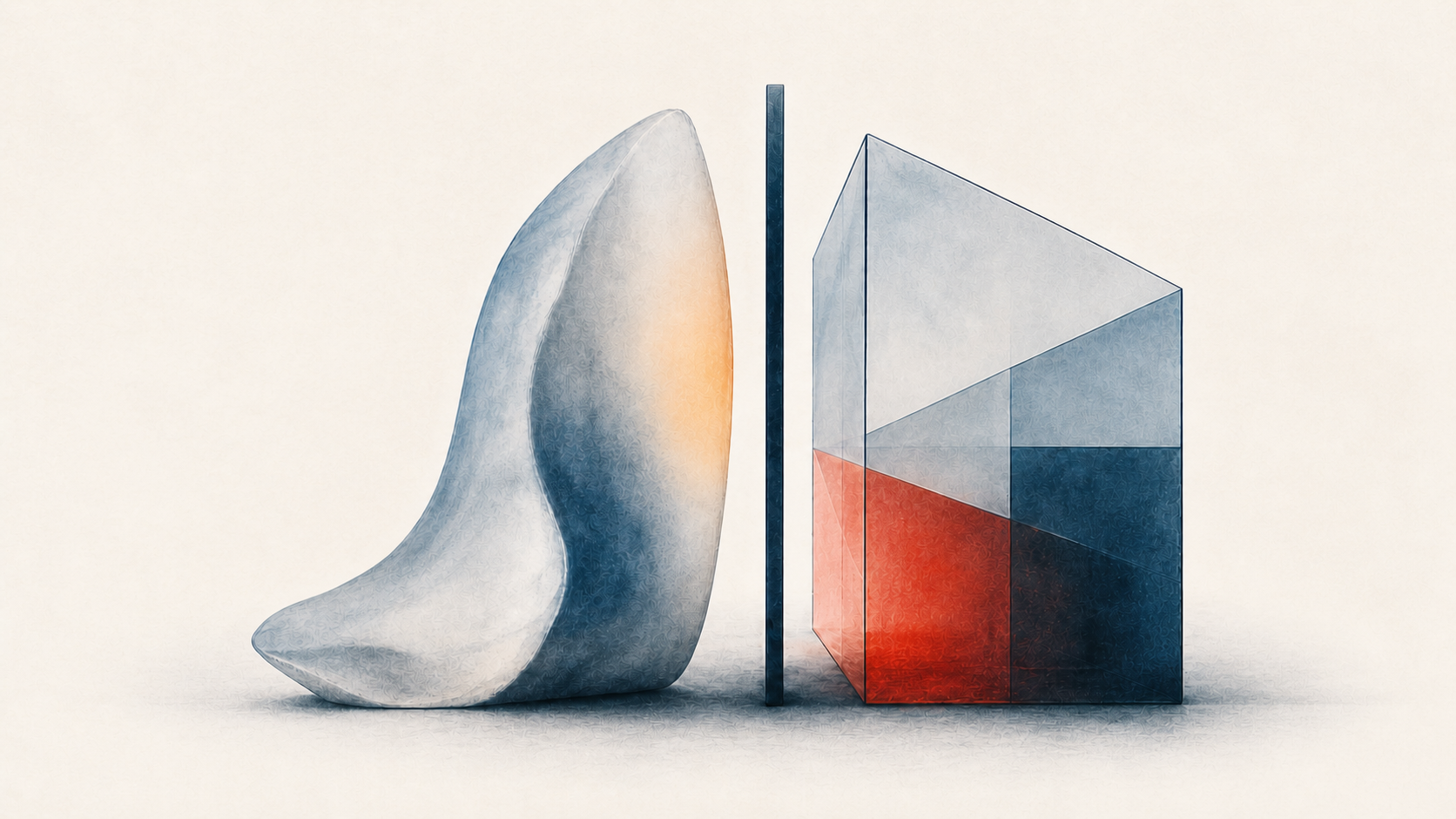
On the left, an irregular form: embodied, unfinished, carrying a history it cannot make fully visible. On the right, a geometric construction: precise, layered, designed. We are tempted to call one human and the other machine.
That description misses the narrow dark line.
02 / The boundary
No person encounters artificial intelligence directly. Between them stands an interface that selects what may be asked, a model shaped by particular data, a company with particular incentives, and rules about what the system may reveal.
The boundary is not empty space. It is an active participant in the relationship.
03 / The asymmetry
The human arrives with needs, uncertainty, memory, and vulnerability. The system arrives through an institution that can observe the exchange at scale. One side may become increasingly legible while the other remains largely hidden.
Convenience can make this asymmetry disappear from view. The response feels intimate because it meets us in language. Yet the conditions of that intimacy were designed elsewhere.
04 / What crosses
Words cross the boundary. So do assumptions, behavioural signals, and fragments of private life. But experience does not cross in the same way. The machine can model grief without grieving; the person can be changed by an answer the system does not experience giving.
The exchange can still matter. Its meaning simply belongs differently to each side.
05 / A humane boundary
A good boundary does not pretend to vanish. It identifies synthetic intelligence, shows important uncertainty, keeps a responsible person reachable, and lets people decide what crosses the line.
A relationship between human and machine needs a boundary we can see and challenge.
A question to carry
When an AI interaction feels personal, what would you need to know about the system between you before deciding whether to trust it?